








Reading time : 8 minutes
The Tech 4 Climate conference questions the role of digital technology in the context of the ecological crisis. Against the backdrop of a challenge for all tech players: how to reconcile digital acceleration and the environmental challenges we face?
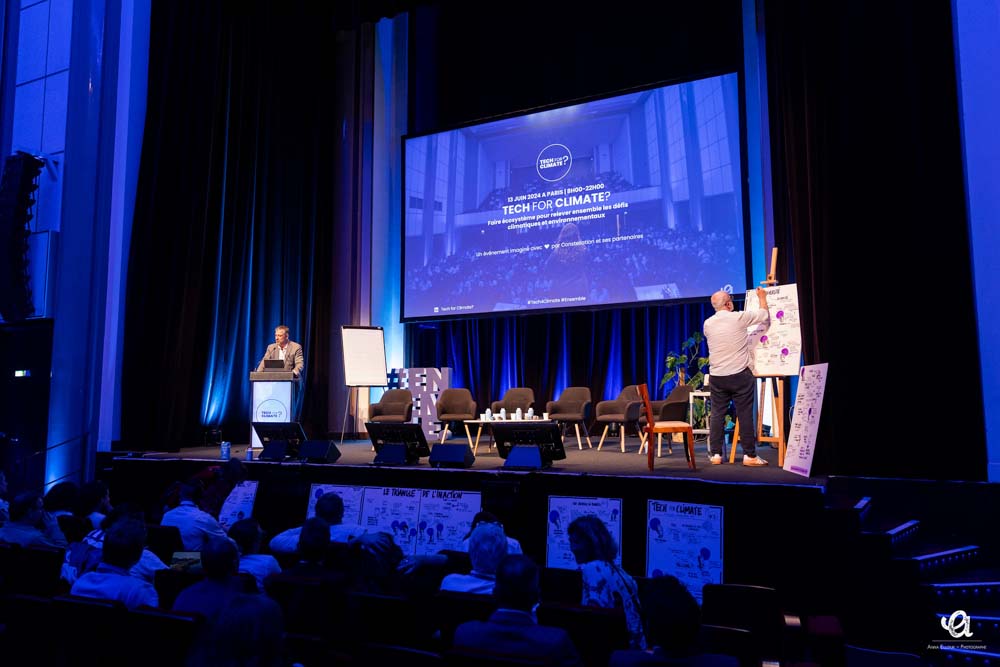
On June 13, Tech 4 Climate brought together various speakers at the Maison de la Chimie, gathered around a day organized in two parts. After a morning dedicated to raising awareness of the impacts of global warming, the afternoon program set about imagining solutions through thematic workshops around responsible digital technology, CSRD, financing of transition or the role of AI.
The observation: we can no longer ignore the need for sustainable management of the resources consumed by digital transformation. However, the transition can accelerate by relying on digitalby taking advantage of its power, but also of its capacity to facilitate cooperation between actors. But we must rethink priorities and prioritize uses. In this regard, note that Tech 4 Climate establishes its own carbon footprint each year (transport, catering).
Black screen, distressing music (from the screen files): against all expectations, it is the INA document from 1976 which opens the day. René Barjavel There he exposes his fear of the vulnerability of our “electronic” world, which totally depends on the circulation of energy.
See the introduction
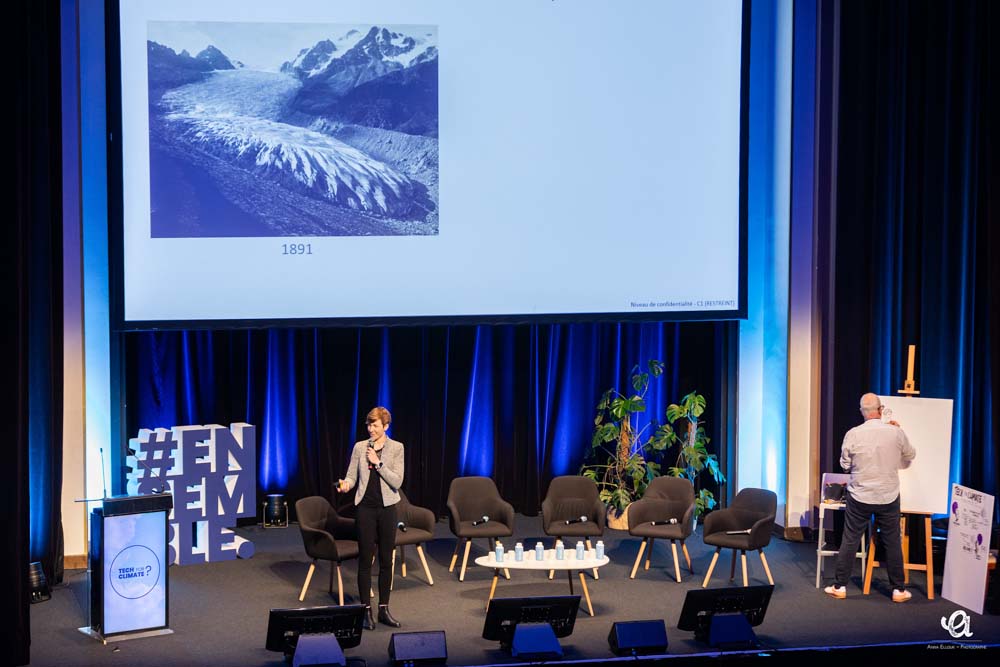
After this chilling introduction, it is precisely the Dr Heidi Sevestreglaciologist and Secretary General of AMAP, the Arctic monitoring and assessment program, who takes the microphone. With infectious energy and enthusiasm, Heidi talks about her career as a glaciologist and her passion for the mountains.
Stories of life and ice cream
Unfortunately, the news is not good. We already know this in part, but Heidi Sevestre provides proof in photos and simulations: over the decades, we see the alarming melting ice capthat of large glaciers, and the dramatic consequences that this can have on mountain environments, such as mountain tsunamis. This is a “brutal emptying of a glacial lake”, as happened in the Himalayas in 2021.
We also learn that glacier water is useful in particular for maintain river flow in summeror even cool power plants, and that 2 billion people on earth use glacier water for at least part of the year. As for the ice cap, it acts as the “white t-shirt” of the planet, in returning part of the solar energy. It is therefore our best weapon against warming, and warming contributes to reducing the ice cover, thus leading to… more warming.
Despite the darkness of the situation, Heidi Sevestre’s keynote aims to bring hope: through the stories of the glaciers that she tells, it is also the lives of the enthusiasts that she meets, and who, on their scale, contribute to fight against global warming and tirelessly document the evolution of glaciers.
See the keynote
How can AI help address environmental challenges?
AI is everywhere, from CIO agendas to user practices. If this generalization of uses naturally raises the question of environmental impact, AI can also provide solutions.
Two round tables were devoted to this subject.
AI: powers, duties and nuisances
Speakers:
- Annabelle BlangeroHead of AI Manager, Senior Manager Ekimetrics
- Pierre-Etienne PommierCEO & founder of Arago
- Emmanuelle BernardinData & AI Manager, Digital Employee experience, GA Digital Program at Rothschild & Co
The first subject addressed is that of reliability of information. With the democratization of generative AI tools, it is becoming increasingly difficult to judge the quality of information. Between fake news, biased, truncated information, even LLM hallucinations, how can we separate things? Pierre-Etienne Pommier recommends establishing common information bases: sharing sources, data and methods in order to limit the risks of incorrect information which will then be broadcast by Chat GPT or Google. The fact is that LLMs hallucinate, and they always will, so we have to figure out how to deal with this flaw.
This also requires having tools, training and technical background, in order to know how to detect hallucinations. Checking and cross-checking sources is not easy for all users. If the press is in crisis today, it could get even worse if the information loses its value, because it is fueled by hallucinations. The race for information, combined with the introduction of AI into search engines to make them drivers of response, could have devastating impacts.
According to a study by Newswatch, there are already more local news sites generated by AI than real sites (1700 AI sites). It is an economic issue for the press, and a democratic issue for the general public.
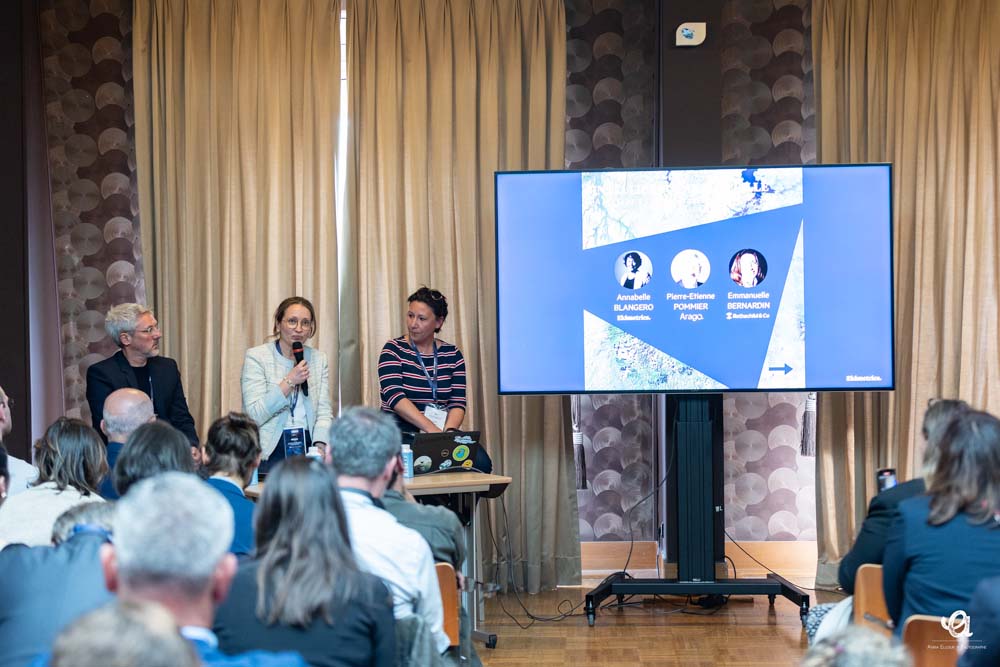
Annabelle Blangero then presented a multi-agent system which responds to this challenge of multiplying sources. “Clear” thus allows you to obtain 3 parallel answers on the risks of AIby synthesizing data from legal bases, white papers and technical resources. The answer obtained thus covers legal, technical and social aspectsby citing its sources, taken from an evolving corpus.
Rothschild & Co, which offers financial services, has organized itself to address the risks linked to AI. As Emmanuelle Bernardin explains, they have internally developed a tool based on CLOTHin order to prevent data leakage in their private Cloud environment. With the resurgence of AI tools among their service providers, it is essential for the company to clarify the rules for using AI tools. Likewise, the AI Act requires Rothschild & Co to rethink its approach to risk.
This proactive approach, however, presents certain difficulties, such as bringing together the skills necessary for a working group dedicated to responsible AI: IT security, legal & compliance, digital & data, IT architecture, etc.
Another point of attention: how not to make the process too cumbersome, when we do not have the skills internally to evaluate responsible AI subjects. The company requested external support to produce a grid based on 8 risksincluding environmental risk. However, as generative AI models are not very transparent, this aspect is still difficult to evaluate.
Copyright and intellectual property are also a risk to be addressed: the company cannot afford to use an image for which it does not have intellectual property. Dall E for example does not allow you to know if an image has been plagiarized; Getty offers a copyrighted base, but with fewer choices for users. You must therefore find the right balance between good risk management and what you authorize, while maintaining your competitive advantage: other companies do not necessarily have the same scruples.
The roundtable ended with an open question on the good use of AI and frugal AI. A question that remains unanswered when many companies use AI to increase production.
See the round table
How can data and AI be a sustainable performance lever for organizations?
Speakers:
- Laurent FelixDG Ekimetry
- Thomas CotinetDirector of ECOLAB, Ministry of the Environment
As Laurent Felix explains, if AI contributes a lot to optimization, it can also lead to non-virtuous models like Shein. There are also virtuous examples of the use of AI, most often oriented around three levers: measurement, optimization, and transformation of sectors.
Laurent Felix cites the example of Action Logement, the leading social landlord in France with 1.1 million homes, which uses AI to better understand its assets, and in particular reduce the consumption of electricity, water, and increase the attractiveness of buildings.
300 pieces of data are collected per building, which represents a lot of work on data governance.
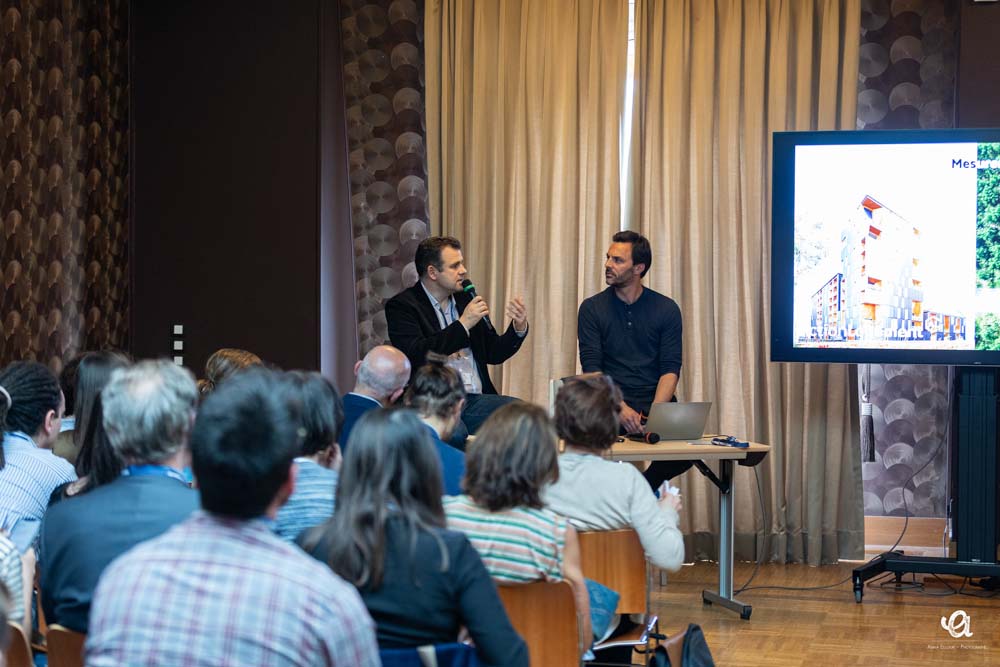
Thomas Cotinet then presented a use case linked to the measurement of soil artificialization in Val d’Oise. Despite the awareness following the IPCC report, and the objectives of zero artificialization set by the Citizen’s Climate Convention, we went from 64 hectares artificialized per year between 2012 and 2017 to 180 hectares per year between 2017 and 2022. Here again , to be able to act and achieve the objectives, it is necessary to know the territory, and therefore to have the right data.
The project carried out jointly by Ecolab and the IGN therefore aims to analyze an incredible mass of photos, on the scale of the whole of France, and to derive precise documentation of land use to within a few centimeters. This project, which mobilizes Data and AI, makes it possible to achieve 75% correct assignments before human intervention. Here AI therefore makes it possible to accelerate the emergence of this reference system, and to make it a decision-making tool.
On an equivalent subject, we led a Data/ML Ops platform project with CLS, aiming to industrialize the process of classifying satellite images of the territory – read in detail here.
See the round table