








PC users buy the majority of their games via Steam (except for certain alternatives such as Epic Games, GOG or launchers specific to the publisher like Blizzard’s Battle.net). As a funnel point with high traffic, that makes the Steam Store page a very precious conversion point in the marketing campaign of the PC game editor. The studios will try to optimize this space to play the steam algorithm and attract attention.
To take advantage of it, large and small studios will be broadcast live at the top of the Steam store page, offering a sense of community and a look behind the scenes. Although this may seem a fact that these steam store pages flow increases commitment, they can be deeply misleading when it comes to assessing the scope of a game. To show you what we mean, we are increasingly examining the effect of the steam audience on live dissemination performance: how do these live flows affect the perception of the success of a game among live audiences, and are they really the best strategy to market your game?
Bases of live streaming on Steam and the Steam store page
Steam provides a detailed user guide for live streaming on its platform that all publishers and streamers should take a look. But from the consumer’s point of view, the essential is as follows: Publishers will organize live flows at the top of their Steam Store pages with a gross gameplay, development flows or (more rarely) streamer collaborations. Steam is currently putting these flows at the top of the page, evaluating them above any other content on the store page, including trailers, game descriptions or opinions. The flow also follows the user on the page when he scrolls (via a contextual window in the area), which means that As long as you are on the Steam Store page, the broadcast plays.
The fact is that these Steam Live flows should not really be live. More often than not, the Steam store page flows are only loop images of an original flow played in rehearsal. Because the cat function do Stay live, however, the flow will say that it is live (a little fallacious). If loop images that follow you, the page annoys you, you can deactivate the broadcasts in your steam settings. It should be noted that there are real streamers on Steam, other than these channels set up by publishers, but we will see in a moment how their impact on the overall steam viewer for a game is relatively negligible.
Steam can seriously swell the game launch show
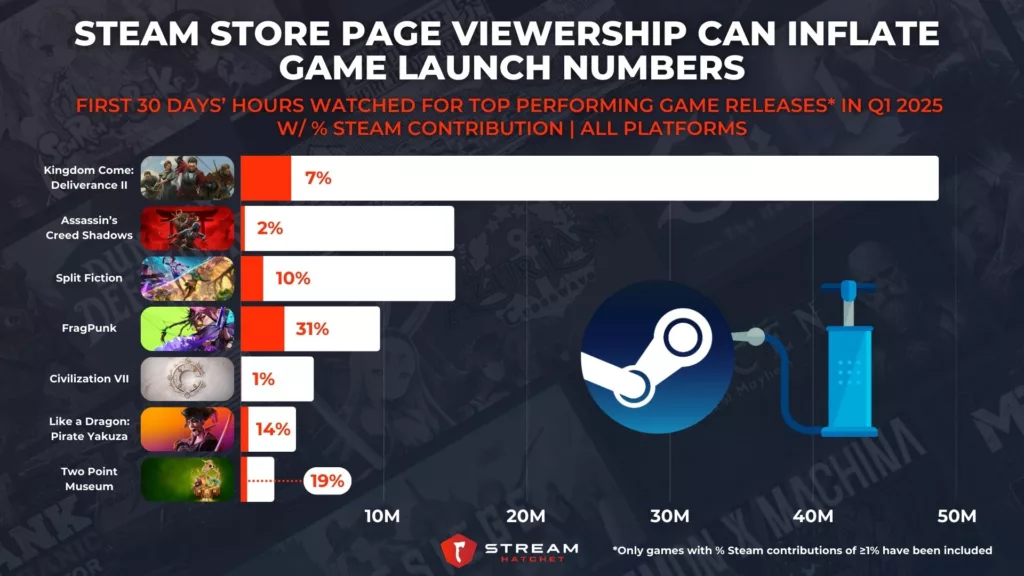
We previously examined how a lot of live success of Steam can be attributed to a new game launches traffic to the broadcasts on the Steam store pages. By diving deeper, we have examined the 20 best game launches since the first quarter of 2025 to see how many significant viewers derived from Steam. It turns out that 7 of the 20 games owe at least 1% of their first 30-day viewer steam while the other 13 games have seen only a few thousand hours on the platform over the same period (including Monster Hunter Wilds,, Annex I,, And Repo). As a funny fact, it should also be noted that two of the launch of the biggest game in T2 2025 also owe millions of steam hours, those being The Elder Scrolls IV: Oblivion remastered And Clear obscure: Expedition 33.
Among these 7 games with important steam audiences, Fragunk opens the way with a huge 3m hour observed during its first 30 days, representing 31% of its total audience during this period. This flow seemed to be a replay of the Shroud vs tenz Twitch Rivals match, a sponsored event promoting the launch of the game. Even through other games, there was still a significant contribution of steam, especially Two -point museum (19%)Like a dragon: Pirate Yakuza in Hawaii (14%), and Divided fiction (10%). However Kingdom Come: Deliverance 2Steam bill represents only 7% of its total audience, which is still 3.5 million hours! With Steam clearly bringing large numbers for play launches, it is worth wondering where this audience comes from exactly.
Steam Store pages are the main contributor to all audience Steam
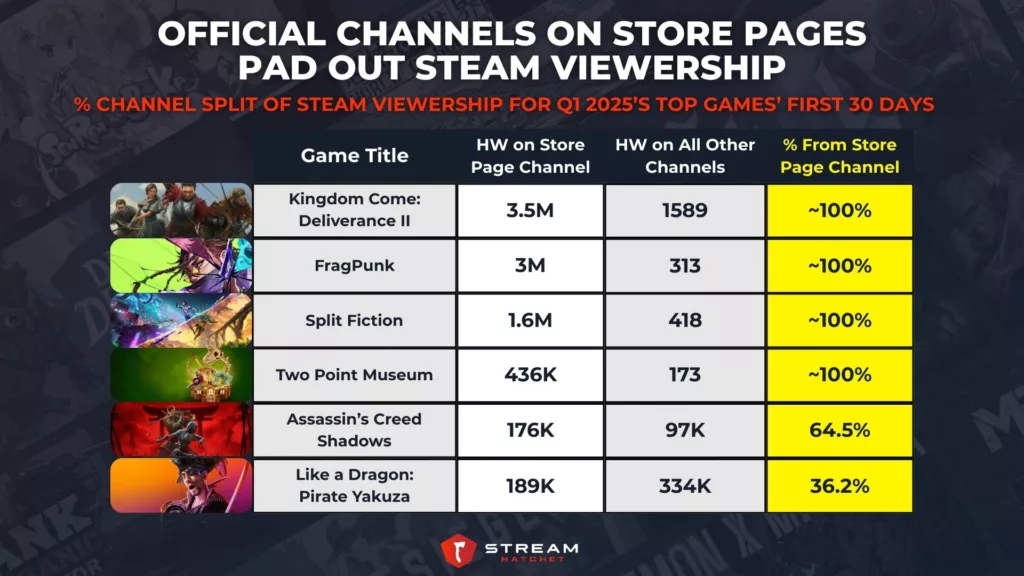
Foresting in these games, we see a clear trend: All these games draw the vast majority of their Steam audience from a single channel, the same channel that broadcast on their Steam Store page. Four of the games (Kingdom Come: Deliverance 2,, Fragunk,, Divided fictionAnd Two -point museum) must essentially 100% of their steam audience to these channels, generally managed by the publisher themselves, that is, in the case of Two -point museumwith a development flow. Assassin’s Creed Shadows is the aberrant value here at 64.5%, generating a little more from its audience of a real sponsored stream (itsjavachip) which reproduced on Steam. Finally, we have Like a dragon: Pirate Yakuza Which is not clear: in addition to the most popular channel at 36.2%, there were two other channels which seem Official (PCBIZ1_SOJ and PCBIZ3_SOJ) firing in the rest of the hearing – but we could not determine what their content was. They can be flows in other languages of the same content.
You might ask yourself why it is important if the steam show comes almost exclusively from the store page rather than “real” steam flows. Keep in mind that as long as the Steam Store page is open, the live flow plays: this means that most of this audience probably comes from passive viewers trying to read criticism or watching trailers rather than real committed viewers. If this is the case, brands must be aware that this hearing is likely to be active viewers. Game publishers must also be careful: if these viewers are already on the store page, the live flow does not really generate awareness, which reduces the power of these figures. Of course, we cannot definitely say that part of these viewers does not actively look at these flows … But we will see accounts below which corroborate this theory.
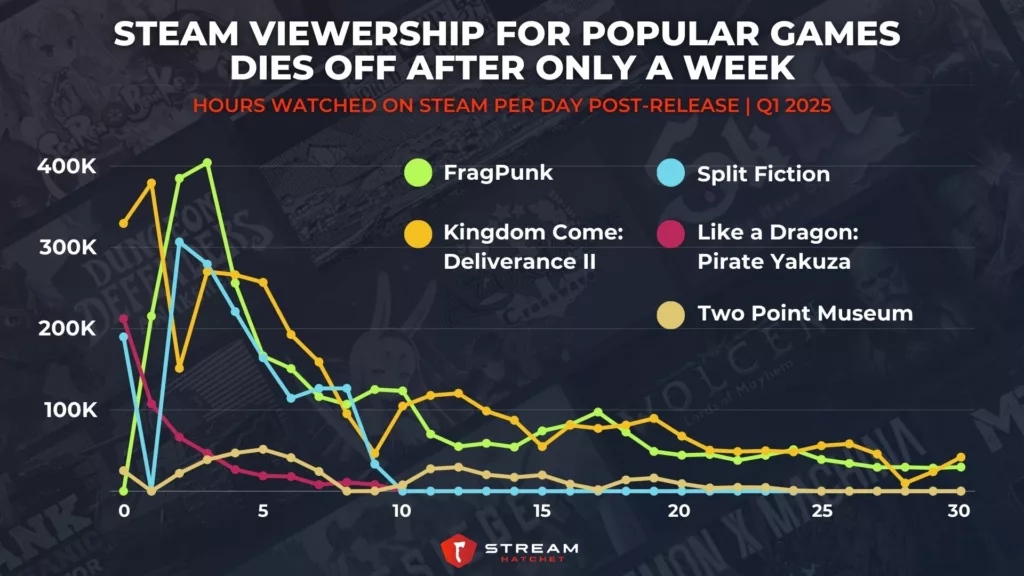
Not only is this audience of very passive viewers, but it also goes out quickly. Looking at 5 of these games, the viewer falls below 100,000 hours a day watched after about 7 to 10 days, usually when the Steam store flow stops working. This makes sense: if most viewers are only people who visit the page to decide if they want to buy the game at the exit, then they are not really interested in the flow and will not return after making their decision. This increase in the first week means that if you judge the performance of a game on streaming live by its first week alone, the inflation effect of the steam viewer becomes even greater. In the end, Steam Stream flow viewers will not remain (especially) and will not follow the live cover of the game (although they can move to other live broadcast platforms).
Should publishers and developers use flows on their Steam Store pages?
Given our concerns about the STEAM store page television, this raises a question: are stores for stores really the best way for game publishers to stimulate sales? There are many factors to consider here, some concerning the awareness generation and others to conversions:
Advantages of pages of the Steam store:
- Book of figures inflated live, which means a higher interest perceived for the title (useful for attracting sponsors, media coverage and media threshing)
- Reached viewers who may not be on other live broadcast platforms with live content engaging
- Favors Steam algorithm which promotes the pages that have broadcast viewers (these games can be presented on the game Hub Topic of the game or the first page of the store)))))
- Demonstrates that the game is actively sustained
- Shows a more human side of the game (important for other developers / players committed)
Consients Steam Store store pages:
- Creates a misleading impression of live interest in the game
- Can be perceived as a nuisance by players trying to see other content on the store page (just ask these redditors)
- Private on the trailers, sometimes showing dull game segments (for example, the queue) instead of a well-polid and organized game
- Slows Store Page Time loading and disrupts the buyer’s experience when he appears late
- Requires resources to maintain the flow during execution (servers, computer feed)
- Can accidentally spoil the elements of the story at the end of the game
Of course, the advantages and disadvantages depend on all the content you create and when you run it. For content, well -known banners with engaging comments and a high and / or interesting gameplay are more likely to capture interest and generate conversions than simple and flat gameplay. Regarding timing, the management of these flows during events like Steam Next Fest means that you access a more open -minded audience that could be curious to see behind the scenes or watch the gameplay for an extended time.
_
What does this mean to judge the performance of launching a live streaming game? In the future, publishers and brands should be careful to reveal the launch metrics to see what proportion of them were stimulated by viewers of the Steam Store page to obtain a more precise image of awareness of awareness of their influencer marketing campaigns. For our part here at Stream Hatchet, we will try to point out this contribution to steam during the coverage of the launching of new games to raise awareness of “real” measures vs “inflated”.
To stay up to date with tips and tips to navigate the live broadcasting industry, follow Stream Hatchet:
Technology
Pendidikan
Pendidikan
Download Anime
Berita Teknologi
Seputar Teknologi